
YMYL Disclaimer: This article is for educational purposes only. It is not medical or legal advice. If you are in an immediate mental health crisis or facing legal workplace issues, please consult a licensed therapist or employment attorney.
Author Note:
This article is written by Hassam Shabbir, Psychologist, Researcher, Author, and Founder of Rise Above Minds. The content is informed by established psychological and organizational research, including Psychological Safety theory (Amy Edmondson), inclusive leadership frameworks, and peer-reviewed studies on hybrid and remote work environments.

The article is reviewed to ensure factual accuracy, clarity, and alignment with current research in the field of workplace psychology. This information is intended for educational purposes only and should not be used as a substitute for professional psychological, medical, or organizational advice.
Table of Contents
TL;DR: The Quick Summary
What is it? Psychological safety in hybrid teams is the belief that you will not be punished or ignored just because you work from home. It ensures that “out of sight” does not mean “out of mind.”
Why does it happen? Safety is challenging to establish due to Proximity Bias. Leaders naturally favor the people they see in the office. This makes remote workers feel invisible and unsafe.
The Damage: It causes anxiety and silence. It leads to Competence Theater, where employees fake understanding to avoid looking weak. This kills innovation.
The Fix: You must build safety on purpose. Use tools like the “Manual of Me.” Leaders must show vulnerability to prove it is safe to make mistakes.
The way we work has changed forever. We used to build trust by sharing coffee in the breakroom. Now, your team might be spread across three time zones.
This creates a new problem called the Hybrid Paradox. People want to work from home. But they also feel lonely and disconnected. When we don’t see each other, we start to worry. Did they read my message wrong? Are they mad at me? Does my boss know I am working?
This fear stops new ideas. To fix it, we need a new kind of trust called Hybrid Psychological Safety.
This guide explains what that is and how to build it using the latest psychology research.
What is Hybrid Psychological Safety?
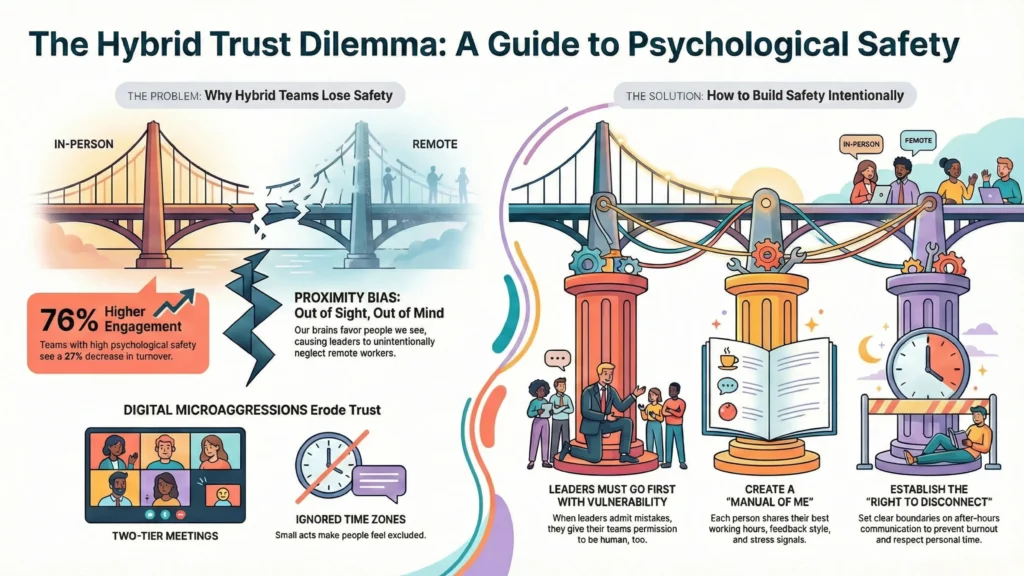
Hybrid psychological safety means you feel safe speaking up, regardless of your location.
It is the belief that you will not be punished or ignored because you work remotely. In a hybrid team, you know that your voice matters. It counts just as much on Zoom as it does in the conference room.
This safety protects you from “Digital Risk.” This is the fear that a text or email will be misinterpreted.
Research Insight: Teams with high psychological safety experience a 27% decrease in turnover and 76% higher employee engagement. When people feel safe, they tend to stay longer and work more effectively.
The 4 Stages of Hybrid Safety
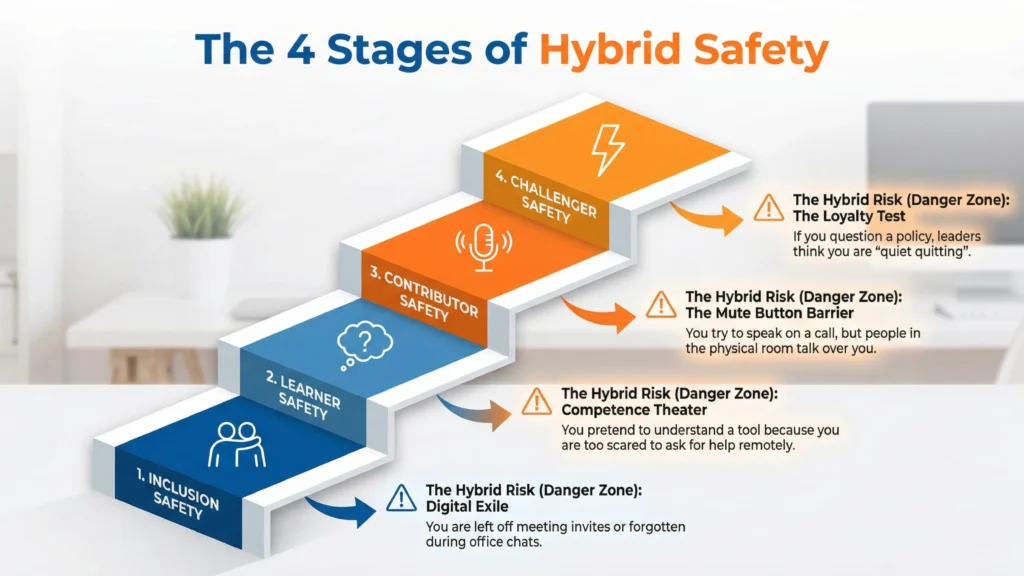
Psychologist Timothy Clark defined four stages of safety. Here is how they look in a hybrid world:
- Inclusion Safety: You feel like you belong.
- Hybrid Risk: “Digital Exile.” You are left off the calendar invites. Or people forget you during office chats.
- Learner Safety: You feel safe to ask questions.
- Hybrid Risk: “Competence Theater.” You pretend to understand a new tool. You are too scared to ask for help remotely.
- Contributor Safety: You feel safe to share your work.
- Hybrid Risk: “The Mute Button Barrier.” You try to speak on a call. But people in the room talk over you.
- Challenger Safety: You feel safe to suggest changes.
- Hybrid Risk: “The Loyalty Test.” If you question a policy, leaders might think you are “quiet quitting.”
Trust vs. Safety: Knowing the Difference
It is essential to understand the distinction between trust and safety.
- Trust is 1-to-1. “I trust you to do this job.”
- Safety is about the Group. “I feel safe speaking up in this meeting.”
In hybrid teams, you might trust your boss. But you might still stay silent in a meeting. This occurs when the group culture is perceived as threatening. You need both to succeed.
The Silent Killers: Why Remote Teams Lose Safety
Why is it so hard to feel safe when we are not in the same room? There are three main threats.
1. Proximity Bias: The Science of “Out of Sight.”
Our brains prefer people we can see. This is called Proximity Bias.
- The Problem: Leaders bond with people they see in the office. They assume office workers are busy because they can see them typing.
- The Result: Remote workers feel invisible. They start working late nights just to “prove” they are valuable. This fear destroys trust.
2. The AI Factor: The Fear of Being Watched
In 2026, many companies are expected to utilize AI tools to track their work. This creates “Algorithmic Anxiety.“
- The Fear: Employees worry that an AI is reading their tone in messages. Or they fear it tracks their mouse movements.
- The Impact: When people feel watched, they stop taking risks. They focus on looking busy instead of doing good work. This creates a “surveillance vibe” that kills trust.
3. Digital Microaggressions
Small behaviors can hurt safety over time. We call these Micro-invalidations.
- The Two-Tier Meeting: People in the room whisper and laugh. People on Zoom sit in silence.
- The Camera Crusade: Forcing Everyone to Keep Cameras On. This creates anxiety for many people.
- The Time Zone Tax: Scheduling meetings at 6 AM or 9 PM for remote staff. This tells them their personal time does not matter.
Measuring the Invisible: Metrics That Matter
You cannot fix what you do not measure. But be careful. Too many surveys can annoy people.
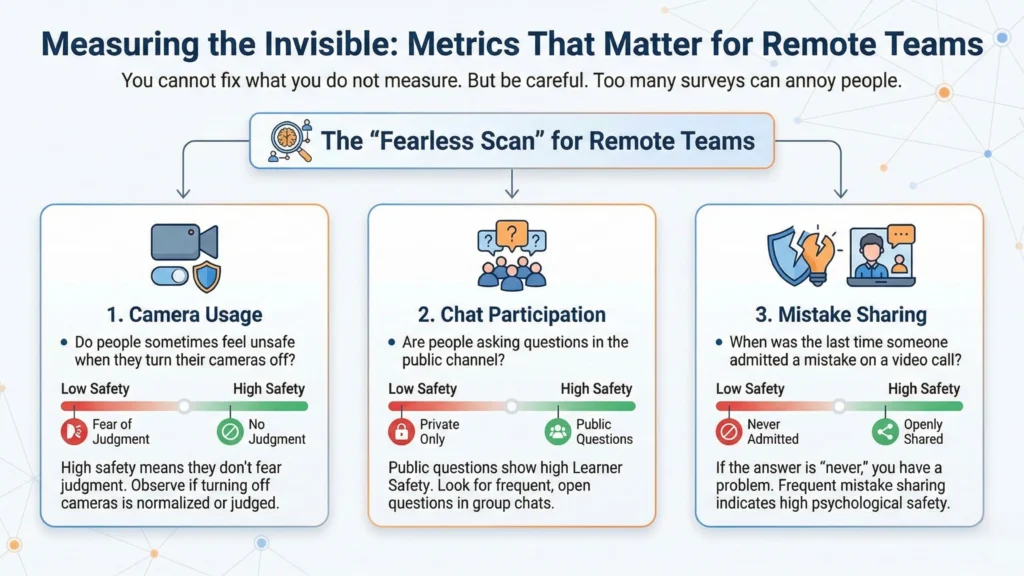
The “Fearless Scan” for Remote Teams
Look for these behaviors in your team instead of a long survey:
- Camera Usage: Do people sometimes feel unsafe when they turn their cameras off? High safety means they don’t fear judgment.
- Chat Participation: Are people asking questions in the public channel? Public questions show high Learner Safety.
- Mistake Sharing: When was the last time someone admitted a mistake on a video call? If the answer is “never,” you have a problem.
Action Plan: Building Safety Asynchronously
You don’t need a team retreat to fix this. You can build safety in your daily work.
The “Manual of Me“
This is a great tool used by companies like HubSpot. Have every team member write a short note that answers:
- “My best working hours are…”
- “I prefer feedback in writing or on video…”
- “A sign that I am stressed is…”
This builds Inclusion Safety without needing to be in the same room.
“Anxiety Parties”
This idea comes from Google Ventures. It sounds scary, but it works.
- Everyone writes down their biggest work worry. (e.g., “I worry I am talking too much in meetings.”)
- The team reads them together.
- Usually, the team says, “We didn’t think that at all!”
This honesty builds massive trust.
The Right to Disconnect
To stop burnout, you must set boundaries. Create a “No-Interruption” rule. Make it clear that sending emails at 8 PM is not required. This protects the team from the “Time Zone Tax.” It prevents the team from burning out by neglecting their own needs.
Leadership Playbook: From Monitor to Facilitator
Leaders set the tone. If you are stressed and watching everyone, they will be scared. If you are open and helpful, they will be safe.
Vulnerability Loops
Leaders must go first. Start your next meeting by saying, “I missed a deadline last week because I was overwhelmed. Here is how I plan to fix it.”
When you admit you are human, you give your team permission to be human too. This lowers fear across the team.
Managing the “Ghost” and the “Micromanager”
- Don’t be a Ghost: If you don’t reply to messages, your team assumes the worst. Be consistent.
- Don’t be a Micromanager: Checking in too often signals a lack of trust. Focus on results, not activity.
Conclusion: The Future of Work is Human
Technology connects us, but it doesn’t create trust. Only people can do that.
Creating safety is the first step. It stops the 12 Stages of Burnout and builds a strong foundation for positive Workplace Psychology.
By fixing Proximity Bias and respecting boundaries, you prevent toxic leadership from taking root. You create a culture where everyone can do their best work, regardless of their location.
Frequently Asked Questions (FAQs)
Can you have psychological safety without trust?
You might trust a colleague’s skills (cognitive trust). But you might still feel unsafe speaking up if the group leader is toxic. Safety is about the group dynamic.
How do I stop proximity bias in meetings?
Use the “Remote-First” rule. If one person is on Zoom, everyone logs into Zoom separately. This gives everyone an equal face on the screen.
Does employee monitoring hurt psychological safety?
Yes, monitoring destroys safety. It creates anxiety and silence. Focus on communicating your outcomes clearly so leaders don’t feel the need to watch your activity.
Key Takeaways:
- Safety > Location: How you feel matters more than where you sit.
- Watch for Bias: Don’t Ignore the People You Can’t See.
- Go First: Leaders must show vulnerability to build trust.
- Respect Boundaries: The “Right to Disconnect” Saves Teams from Burnout.