

YMYL Disclaimer: This article is for educational purposes only. It is not medical or legal advice. If you are in an immediate mental health crisis or facing legal workplace issues, please consult a licensed therapist or employment attorney.
Author Note: Written by Hassam Shabbir (Psychologist, Researcher, Author & Founder, Rise Above Minds). This article is reviewed for accuracy against clinical frameworks, including the Toxic Triangle and Dark Triad models.
TL;DR: The Quick Summary
- What is it? Toxic leadership is a pattern of behavior in which a leader harms employees and the company to feed their own ego or seek power.
- Why does it happen? It takes three things: a bad leader, followers who obey, and a chaotic environment. This is called the Toxic Triangle.
- The Damage: It causes memory loss and chronic anxiety. It pushes employees rapidly through the 12 Stages of Burnout.
- The Fix: You must document everything using a factual log. Recovery often requires removing yourself from the toxic environment.
Table of Contents
What is Toxic Leadership Psychology?
Toxic leadership is a systemic process where leaders consistently use destructive behaviors, like manipulation and intimidation, to inflict serious harm on their followers and the organization.
It is important to know the distinction between a “bad boss” and a “toxic leader.” A bad boss might just be unskilled. A toxic leader creates poison. In fact, research indicates that up to 56% of employees work for a leader whose behavior fosters an unhealthy environment (Life Meets Work).
- Toxic Leadership: This spreads like a poison. The leader is driven by self-interest and does not care about your well-being.
- Abusive Supervision: This is specific, hostile behavior. It includes yelling, ridiculing, or giving you the silent treatment.
- Destructive Leadership: This focuses on the results. It is behavior that hurts the organization’s goals. Sometimes, these leaders achieve short-term financial results, but they ultimately harm the team in the long run.
Key Takeaway: Incompetent leaders make mistakes. Toxic leaders intentionally manipulate or harm people to keep power.
The Toxic Triangle: Why It Happens
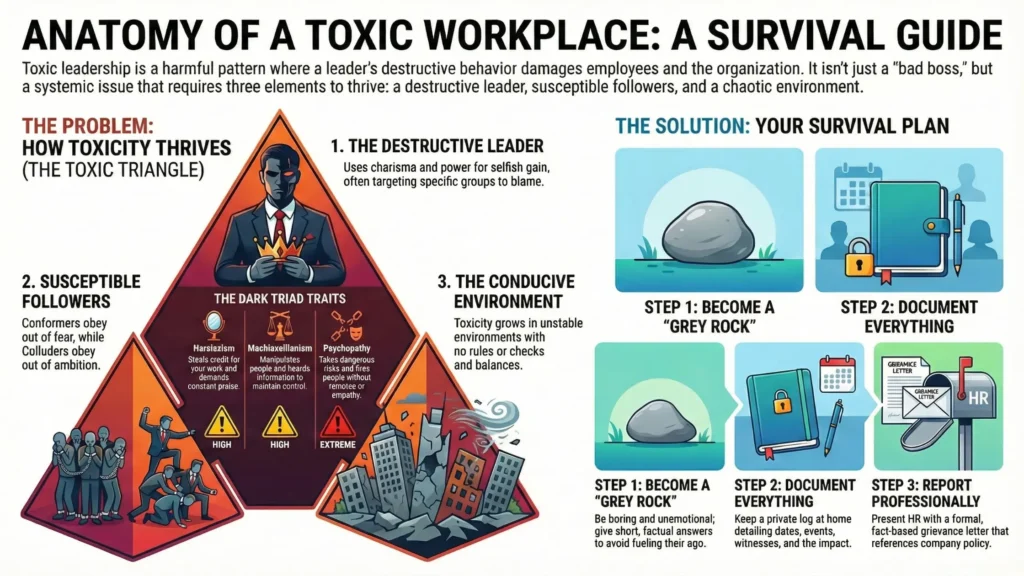
The Toxic Triangle is a model that suggests toxic leadership requires three key elements to thrive: a destructive leader, susceptible followers, and a chaotic workplace.
This framework, developed by Padilla, Hogan, and Kaiser (2007), demonstrates that toxicity isn’t solely the fault of one person—it is a systemic issue.
1. The Destructive Leader
This person has charisma but uses it for selfish power. They often have an “ideology of hate” where they target specific groups to blame.
- Case Study: “Tiger Mike” Davis, a Houston oilman, issued memos forbidding employees from speaking to him and firing “hippies.” His hatred created a culture of terror.
2. Susceptible Followers
Followers fuel the fire. Research by Thoroughgood et al. (2012) identifies the “Susceptible Circle” of followers:
- Conformers (The Fearful):
- Lost Souls: They have low self-esteem and follow the leader to feel safe.
- Bystanders: They stay silent out of fear. They want to avoid punishment.
- Colluders (The Ambitious):
- Opportunists: They obey because they are ambitious. They want to be like the leader to get promoted.
- Acolytes: They are “true believers” who actually share the leader’s toxic values.
Empathy Note: If you stayed in a toxic job, you aren’t weak. The system is designed to prey on your need for safety (Conformer) or your desire to succeed (Colluder).
3. The Conducive Environment
Toxicity grows in unstable places. It happens in environments with no “checks and balances” or during a crisis. If the company ignores rules to make money, toxic leaders take control.
Learn more aboutpsychological safetyin our deep dive.
The Dark Triad in the Workplace
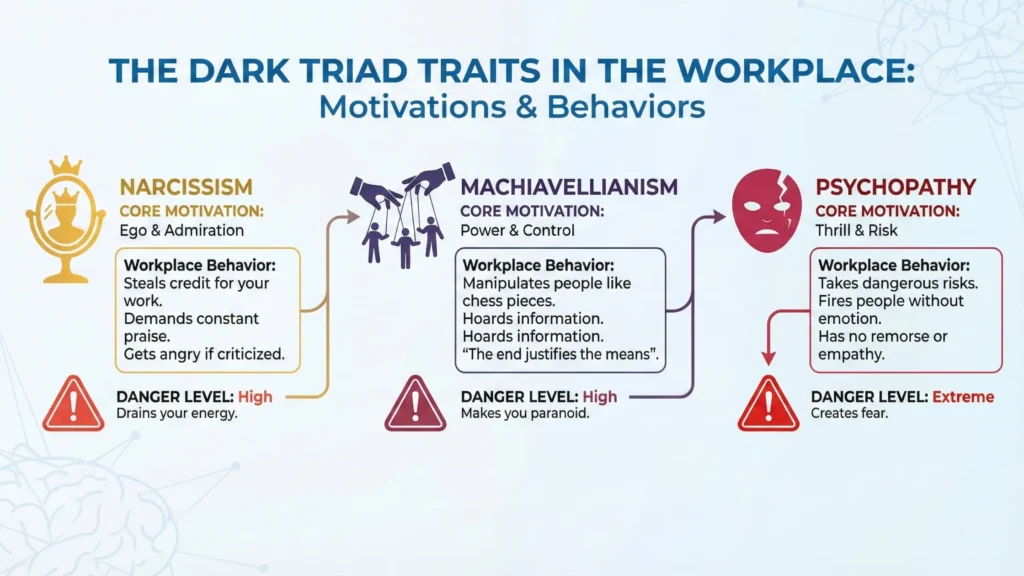
The Dark Triad is a group of three personality traits—Narcissism, Machiavellianism, and Psychopathy—that often appear in bad bosses.
Psychologists use these traits to identify patterns in leadership styles (Paulhus & Williams, 2002).
| Trait | Core Motivation | Workplace Behavior | Danger Level |
| Narcissism | Ego & Admiration | Steals credit for your work. Demands constant praise. Gets angry if criticized. | High. Drains your energy. |
| Machiavellianism | Power & Control | Manipulates people like chess pieces. Hoard information. “The end justifies the means”. | High. Makes you paranoid. |
| Psychopathy | Thrill & Risk | Takes dangerous risks. Fires people without emotion. Has no remorse or empathy. | Extreme. Creates fear. |
See also: The Dark Triad.
Mechanisms of Control: How They Break You
Toxic leaders use specific psychological manipulation tactics to maintain dominance and prevent followers from realizing the abuse.
- Gaslighting (Trivialization): The leader minimizes your feelings to make you doubt your reality. They say things like, “You are too sensitive” or “I never said that “.
- Grand Illusions: They promise a “noble vision” (such as saving the company) to trick you into working until you burn out. It is a lie to get your obedience.
- Isolation: They cut you off from your team. They might lie and say, “The team doesn’t like you,” to keep you dependent on the leader.
- Moving Goalposts: You reach a goal, but it’s immediately changed. You never succeed. This keeps you in a state of constant anxiety.
Real-World Example: At Uber under Travis Kalanick, a “bro culture” flourished where high performers were protected even when they harassed others. The environment silenced victims and rewarded aggression.
Quiet Firing & Constructive Dismissal
Quiet firing occurs when a boss gradually reduces your workload or support to encourage you to quit on your own.
Bosses have used this tactic for decades, but “quiet firing” has given it a name. It hurts because being ignored activates the pain centers in your brain.
The Quiet Firing Checklist:
- [ ] You are suddenly left off email chains you used to be on.
- [ ] Your 1-on-1 meetings are frequently canceled or “forgotten.”
- [ ] You receive no feedback for weeks, good or bad.
- [ ] Projects are taken away without explanation.
- [ ] You are excluded from team meetings or social events.
The Legal Reality: In many places, this is Constructive Dismissal. This means the employer made the workplace so bad that you had to quit.
Mind & Body Impact: The Cost of Stress
Toxic bosses cause real physical harm by keeping your body’s stress system stuck in overdrive.
Your body reacts to a toxic boss as if it were under physical attack.
- Brain Fog: High levels of stress hormones (cortisol) shrink the memory center (hippocampus) of your brain. You aren’t crazy; your brain is injured.
- Betrayal Trauma: This happens when someone you depend on (like a boss) hurts you. It confuses your brain and causes severe anxiety because you need the job but fear the person.
- Conservation of Resources (COR) Theory: Think of your energy like a phone battery. A toxic boss drains your battery faster than you can charge it. You have nothing left for life outside work.
YMYL Note: If you are having flashbacks, panic attacks, or cannot sleep, please talk to a licensed therapist. These are signs of workplace PTSD.
From Toxicity to Burnout: The 12 Stages
Toxic environments can quickly push you through the 12 stages of burnout by draining your mental energy faster than you can recharge.
We can map the leader’s behavior directly to Freudenberger’s burnout model.
| Toxic Trigger (The Cause) | Burnout Stage (The Result) | What It Feels Like |
| Narcissistic Demands | Stage 1: Compulsion to Prove | “If I work harder, they will finally like me.” |
| Abusive Supervision | Stage 3: Neglecting Needs | You stop sleeping or eating to avoid the boss’s anger. |
| Gaslighting | Stage 4: Displacement | You feel angry but blame your spouse instead of your boss. |
| Culture of Fear | Stage 6: Denial | “It’s not that bad. He’s just stressed.” |
| Psychopathic Callousness | Stage 9: Depersonalization | You feel numb. You stop caring about the work to survive. |
Learn more: 12 Stages of Burnout.
What To Do: Your Survival Plan
To survive, you must stop reacting emotionally and start documenting facts to protect yourself.
Leaving without a plan can leave you more vulnerable. Protect yourself first.

Step 1: The “Grey Rock” Method
Be boring. Do not show emotion to the leader. Give short, factual answers. If they can’t get a reaction, they might lose interest.
Step 2: The Documentation Log
You need proof. Keep a journal at home, not on a work computer.
| Date & Time | Event Description | Witnesses | Impact |
| Oct 12, 2:00 PM | The boss yelled, “You are useless,” in the hallway. | Sarah J., Mike T. | Felt panic, heart racing. Unable to finish report. |
| Oct 14, 9:00 AM | The boss denied approving the project (Gaslighting). | None (1:1 meeting) | Confused. Sent email to confirm conversation. |
Step 3: The Grievance Letter
When visiting the HR department, please maintain a professional demeanor at all times. Use this template structure:
Subject: Formal Grievance regarding [Name]
Statement of Facts: On [Date], [Name] engaged in [specific behavior, e.g., hostile verbal communication].
Evidence: This contradicts the company policy on [Respect/Harassment]. Please see the attached log of 5 incidents.
Impact: This behavior is affecting my ability to perform my duties in the following ways: [specific implications].
Desired Outcome: I am requesting [mediation/transfer/investigation].
For Companies: Prevention Steps
Companies can prevent toxic leaders by utilizing anonymous feedback and screening for dark personality traits during the hiring process.
- Stop “Kiss Up, Kick Down”: Toxic leaders are nice to bosses and mean to teams. Utilize 360-degree reviews to enable teams to report the truth anonymously.
- Screen for Dark Triad: Use psychological assessments (like the Hogan Development Survey) during hiring to spot dangerous traits early.
- Fix the Environment: If a high-performer is toxic, consider terminating their employment. Keeping them proves that money matters more than safety. Uber had to fire its CEO to finally address its toxic culture finally.
FAQs
Can a toxic boss cause PTSD?
Yes. Prolonged exposure to abuse can cause “workplace PTSD.” Symptoms include flashbacks, hypervigilance (always being on guard), and severe anxiety. This is often linked to the betrayal of trust by a leader.
Is quiet firing illegal?
Quiet firing is not a legal term. However, the actions (such as cutting hours or excluding you) can constitute Constructive Dismissal. This is illegal in many places.
What are the three types of toxic leaders?
The Dark Triad identifies them as: 1) Narcissists (entitled), 2) Machiavellians (manipulators), and 3) Psychopaths (callous/impulsive).
Conclusion
Toxic leadership isn’t just about clashing styles—it’s about real harm. The Toxic Triangle reveals that it takes a poor leader, a fearful team, and a weak system to create this mess. If you find yourself in this situation, be aware that your “brain fog” and stress are normal biological responses to an abnormal environment. Use the documentation log. Protect your sanity. Plan your exit.