
TL;DR
Understanding the different stages of burnout is vital because burnout is a biological progression, not just a bad mood. It often begins with “Quiet Cracking,” where high performers maintain output while crumbling inside. This guide compares clinical models to help you self-assess your current mental state. We explain the shift from chronic stress to collapse of the HPA axis (the body’s stress-control system). Finally, we provide science-backed protocols for nervous system recovery.
Model Answer: What Are the Stages of Burnout?
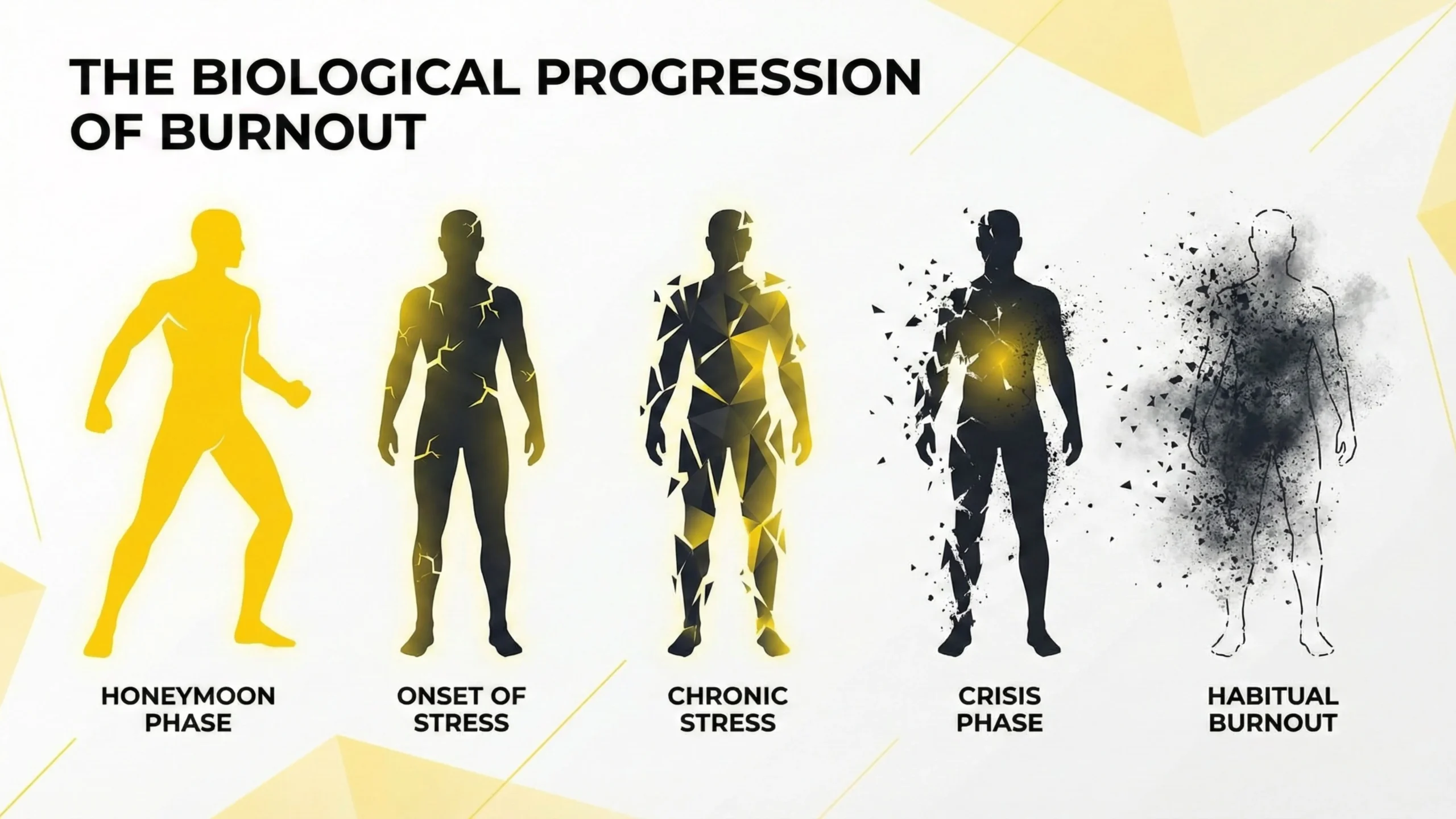
Burnout is a biological progression, not just a bad mood. It typically evolves from “Quiet Cracking” (maintaining high performance while psychologically eroding) to HPA axis dysregulation (physiological collapse). While the 5-stage model tracks the onset of chronic stress from the “Honeymoon Phase” to “Habitual Burnout,” the 12-stage model details the behavioral decline from ambition to total breakdown.
YMYL Disclaimer: This content is for informational purposes only and does not constitute medical advice. If you are experiencing a mental health crisis, please consult a qualified healthcare professional.
Table of Contents
Fact Block: The Hidden Stages of Burnout
Burnout is not just “being tired”,it is a biological process that changes how your brain works. Here are the facts you need to know to spot it before you crash:
• The “Quiet Cracking” Trap: You might think you are safe because you are still hitting your deadlines. But “Quiet Cracking” is a real stage where you maintain high performance on the outside while emotionally detaching on the inside.
• Stage 1 Looks Like Success: Surprisingly, the first stage of burnout isn’t exhaustion; it is “Excessive Ambition” (The Compulsion to Prove Oneself). You ignore your own needs to work harder, thinking it is just “dedication”.
• The “Robot” Mode (Depersonalization): Do you feel like you are on autopilot? This is a clinical symptom where you feel disconnected from your own body and cynical toward others. It is a major warning sign that your brain is trying to protect itself by shutting down emotions.
• Your “Off Switch” is Broken: Burnout physically damages your HPA Axis (the body’s stress control center). This leaves you feeling “wired but tired”, you are exhausted, but your body has forgotten how to relax or sleep.
• A Weekend Won’t Fix It: Once you reach the final stages of burnout (Collapse), a vacation is not enough. True physiological recovery of the nervous system typically takes 6 to 18 months of active rest and therapy.
The Invisible Break: What Is Quiet Cracking?
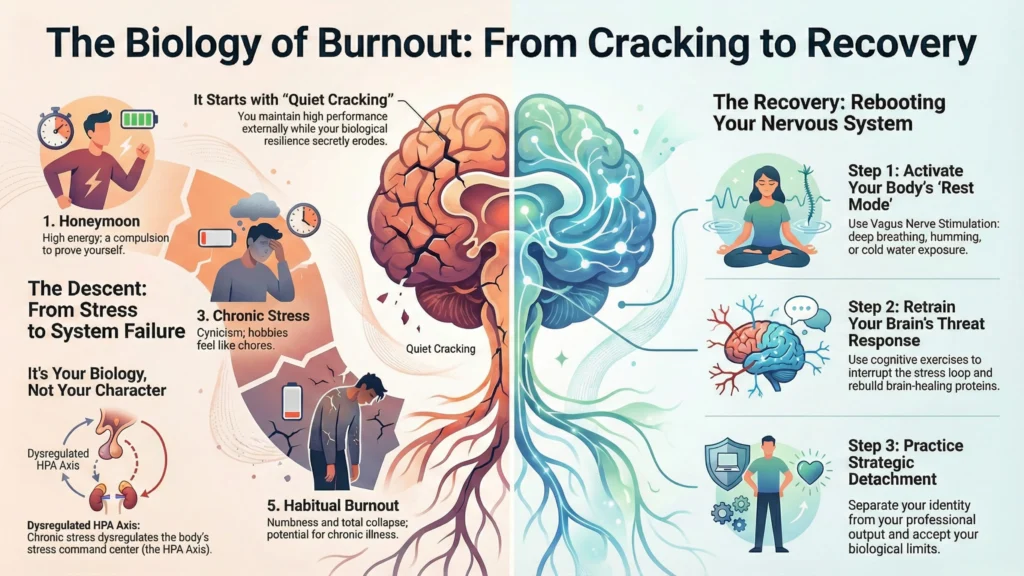
You aren’t quitting. You are cracking. It costs you your biological resilience.
The conversation has shifted in 2026. We now talk about Quiet Cracking.
You maintain high performance externally. But internally, you are eroding.
A 2025 TalentLMS report indicates that 54% of employees share this sentiment. It is dangerous because it is invisible.
You still hit KPIs. You still answer emails. But emotionally, you have already checked out.
This aligns with Workplace Psychology principles. Proving yourself masks the damage.
Quiet Cracking is an early phase of burnout. It maps to Freudenberger’s first three stages.
These are proving oneself, working harder, and neglecting needs.
In simple terms, you are running on empty without realizing it. You run on adrenaline and cortisol. (Cortisol: Your primary stress hormone)
You push through fatigue because you feel you have no choice.
The Biology of Burnout: It’s Not Just In Your Head
Burnout is not a failure of character. It is a failure of your HPA Axis. (HPA Axis: The body’s stress-response command center)
Stress signals your adrenal glands to release cortisol. This helps during short bursts.
However, in a modern office, stress is a constant presence. This pressure leads to HPA Axis Dysregulation.
NIH research suggests that your body may become less effective at regulating stress hormones. In simple terms, the body loses its “off switch” for stress.
This leads to Allostatic Load. (Allostatic Load: The wear and tear on the body from chronic stress)
You might feel “wired but tired.” You might have memory fog or anxiety spikes.
Medical consensus distinguishes this from “adrenal fatigue”. Your glands are not tired. Your brain’s command center is offline.
Comparing the Frameworks: 5 Stages vs. 12 Stages
Knowing your Model is critical for diagnosis. The 5-Stage Model works for quick self-assessment.
The 12-Stage Model shows detailed behavioral decline. Here is how they map onto each other:
| 5-Stage Model | 12-Stage Model | What It Feels Like |
| 1. Honeymoon | 1. Compulsion to Prove | High energy. You feel you must succeed. |
| 2. Stress Onset | 3. Neglecting Needs | Jittery. Skipping lunch. Irritability creeps in. |
| 3. Chronic Stress | 5. Revision of Values | Cynicism. Hobbies feel like chores. |
| 4. Burnout | 8. Behavioral Changes | Numbness. You are on autopilot. |
| 5. Habitual Burnout | 11. Depression | Total collapse. Chronic illness. |
For a detailed examination of behavioral progression, read our in-depth analysis of The 12 Stages of Burnout.
The Neuro-Corporate Link
Why do we do this? It is often a response to unsafe environments.
This happens when the brain perceives work as a constant threat. Your amygdala stays active when you feel unsafe. (Amygdala: The brain’s threat detection center)
Low Psychological Safety keeps teams in a state of hyper-arousal. Employees overwork to avoid criticism.
Constant activation of the nervous system prevents recovery. This blocks the Vagus Nerve. (Vagus Nerve: The nerve that tells your body to rest)
You cannot think your way out of it. You must calm your nervous system physically.
Alternative Ways to Measure the Crash
While Freudenberger’s 12 stages map your behavioral decline, clinical psychology uses specific tools to measure the severity of your condition. If you are trying to quantify your burnout, these are the three primary frameworks used by professionals:
1. Maslach Burnout Inventory (MBI) The “Gold Standard” used in 88% of research. It measures burnout across three dimensions: emotional exhaustion, depersonalization, and reduced personal accomplishment.
• Pro: Highly validated with extensive historical data for comparison.
• Con: It is proprietary (paid) and does not yield a single diagnostic “burnout score”.
2. Burnout Assessment Tool (BAT) A modern framework that views burnout as a syndrome. It adds “cognitive impairment” (brain fog) and “emotional impairment” to the standard definition.
• Pro: Provides a single composite score and measures the inability to think clearly.
• Con: Newer framework with less historical benchmarking than the MBI.
3. Copenhagen Burnout Inventory (CBI) Focuses strictly on fatigue. It breaks burnout into three categories: personal, work-related, and client-related.
• Pro: Free to use and excellent for identifying pure physical/psychological exhaustion.
• Con: Heavily focused on fatigue, potentially missing the “cynicism” or “detachment” dimensions.
Recovery Protocols: Fixing the Machine
Boundary setting works in the early stages. Later stages require physiological repair.
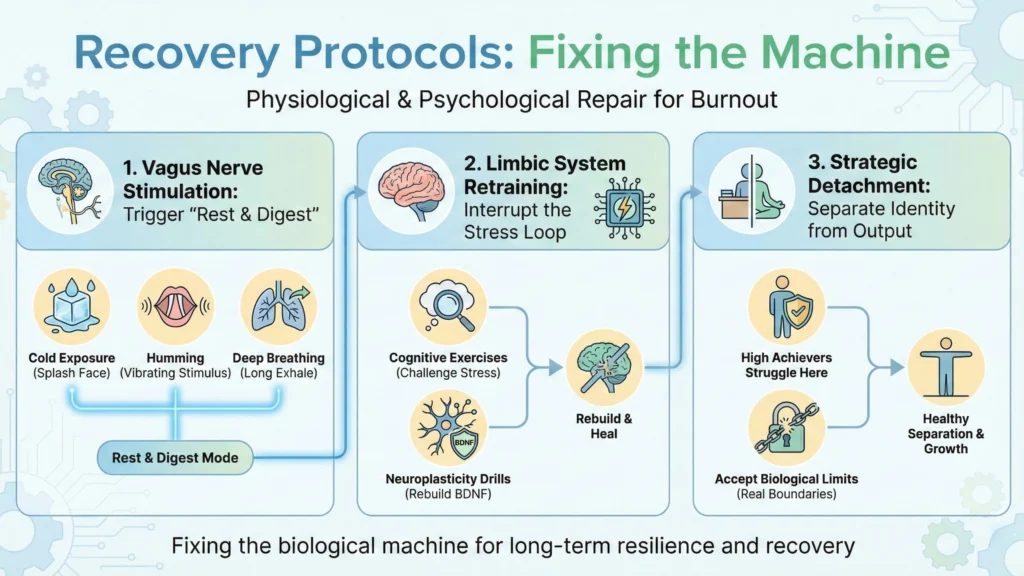
1. Vagus Nerve Stimulation:
Trigger your “rest and digest” mode manually.
- Cold Exposure: Splash cold water on your face.
- Humming: Vibrating vocal cords stimulate the nerve.
- Deep Breathing: Exhale for a longer duration than you inhale.
2. Limbic System Retraining:
Your brain fears work. You must interrupt the loop.
Use cognitive exercises to challenge the stress response. Perform neuroplasticity drills to rebuild BDNF. (BDNF: A protein that helps your brain grow and heal)
3. Strategic Detachment:
Separate your identity from your output. High achievers struggle here. Accept that your biological limits are real.
People Also Ask
What are five stages of burnout?
The five stages are the Honeymoon Phase (ambition), Onset of Stress, Chronic Stress, Burnout (symptoms become critical), and Habitual Burnout (symptoms are embedded in your life).
What are the four stages of burnout?
The four stages are Engagement and Enthusiasm, the Breach in the Job Ideal (disappointment), Protective Withdrawal (reducing effort), and Clinical Burnout.
What is the 42% rule for burnout?
This rule posits that humans require approximately 42% of their day (about 10 hours) for sleep, rest, and connection to effectively process stress and prevent burnout.
What is the final stage of burnout?
The final stage is Burnout Syndrome or “Collapse,” where the body and mind shut down, often resulting in chronic illness or the need for immediate medical attention.
Is burnout a nervous breakdown?
Technically no; burnout is an occupational phenomenon, but if left untreated, its final stage can lead to a total physical and mental collapse that mimics a nervous breakdown.
Frequently Asked Questions
What are the5 stages of burnout?
The 5 stages are Honeymoon, Stress Onset, Chronic Stress, Burnout, and Habitual Burnout.
What is the difference between quiet Cracking and burnout?
Quiet Cracking is internal erosion with high output. Burnout is the final structural failure.
How long does it take to recover from burnout?
Mild cases take 1-3 months. Severe cases take 6-18 months of professional therapy.
Can burnout be reversed?
Yes. The brain heals through neuroplasticity. This requires active nervous system regulation.
Author Note: This article is written by Hassam, a Workplace Psychology specialist focused on human behavior, burnout, leadership dynamics, and modern work environments.
The insights shared here are based on applied psychology principles, real-world observations, and ongoing research into how people experience work in today’s evolving workplaces.